Real Estate Photography Equipment: The 2026 Checklist
Aug 3, 2026 · 10 min read
The real estate photography equipment that actually pays for itself: camera, lens, tripod, lighting, drone and software picks across 3 budget tiers for 2026.
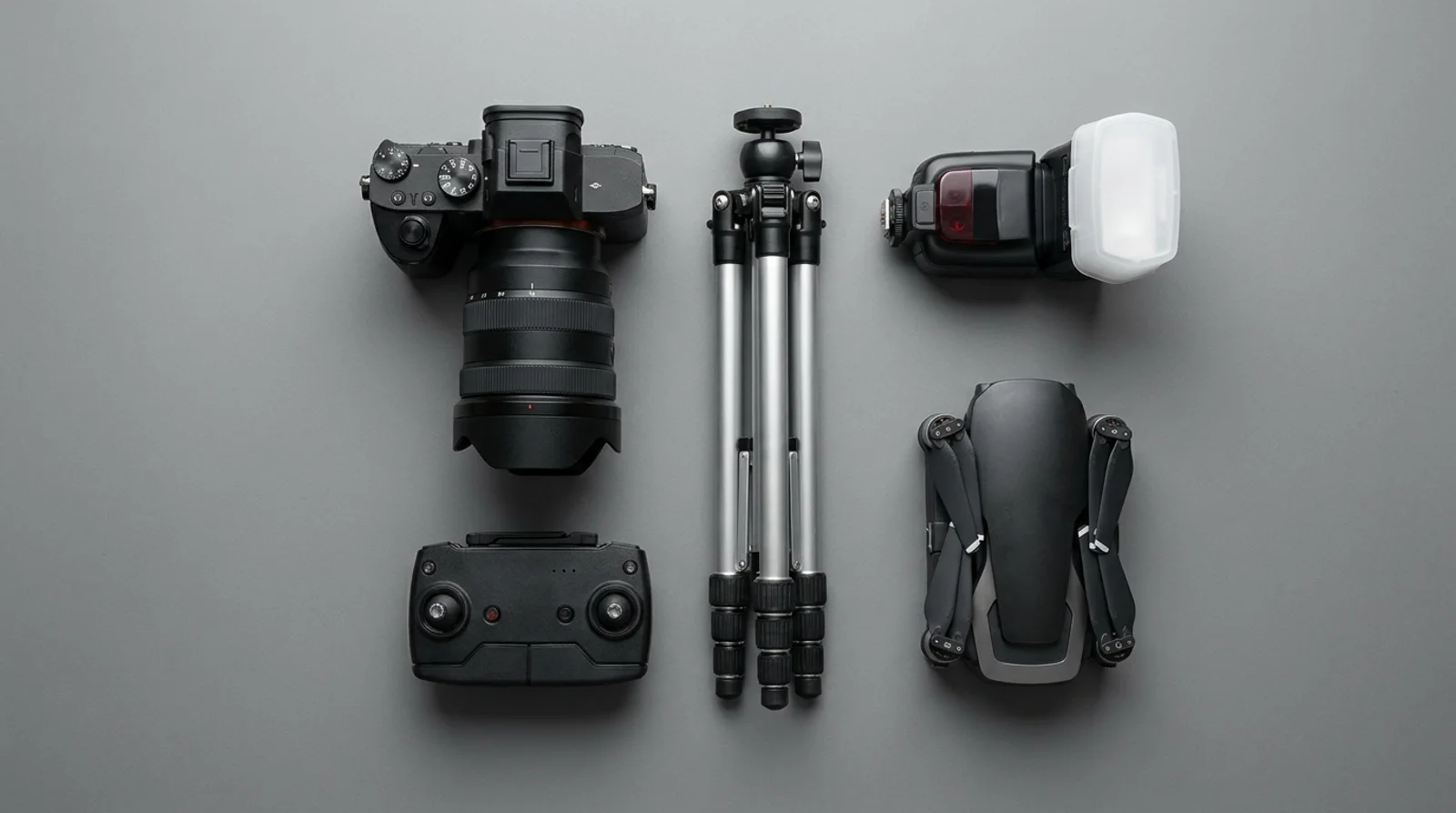
Real estate photography equipment breaks down into three honest tiers: a starter kit under $1,500, a working-pro setup between $3,000 and $6,000, and a luxury kit that can run $10,000 or more. The camera and lens matter most, but tripod, lighting, drone, and software decisions are what separate photographers who reinvest their margin wisely from those who overspend on gear they don't need. This checklist covers exactly what to buy at each tier, and just as importantly, what to skip.
Every dollar you put into real estate photography gear should either speed up your turnaround or raise the ceiling on what you can charge. That's the lens (pun intended) to run every purchase through.
Starter Kit: Under $1,500
This is the minimum viable setup for booking your first paying real estate shoots. It won't win you luxury listings, but it will produce clean, well-exposed interiors that agents are glad to have same-week.
| Category | Pick | Typical price |
|---|---|---|
| Camera | Entry APS-C mirrorless (Canon EOS R10, Sony a6100) | $650-800 |
| Lens | Wide-angle zoom or prime, 10-18mm APS-C equivalent | $300-450 |
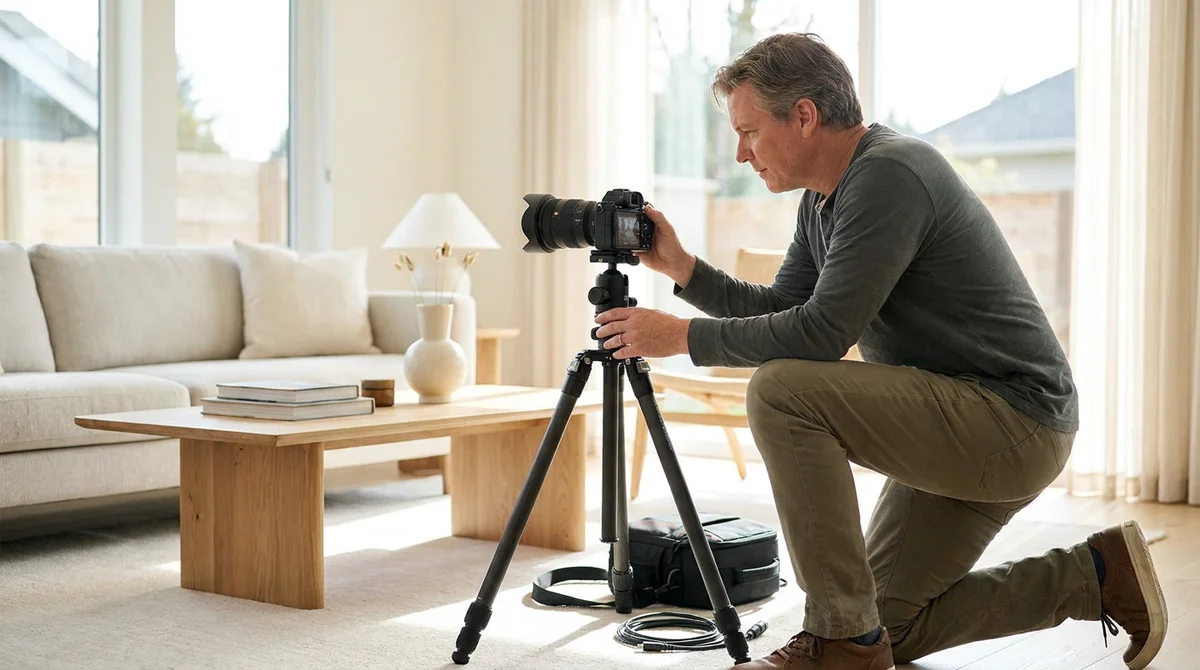
| Tripod | Aluminum travel tripod with a bubble level | $50-100 |
| Lighting | None required: bounce a single on-camera flash off the ceiling | $0-120 |
| Drone | Skip: rent or subcontract for the rare listing that needs it | $0 |
| Software | Adobe Lightroom (Photography plan) | $10/month |
Total: roughly $1,000-1,500, plus a memory card and a spare battery. The lens is the one place not to cut corners: a kit zoom with visible barrel distortion will make every room look warped, and that's the fastest way to lose a repeat client.
Working-Pro Kit: $3,000-6,000
This is the tier most full-time real estate photographers settle into. It's built for volume: five to eight listings a week, consistent quality, and a turnaround fast enough to compete on same-day delivery.
| Category | Pick | Typical price |
|---|---|---|
| Camera | Full-frame mirrorless (Sony a7 IV, Canon EOS R6 Mark II, Nikon Z6 III) | $2,000-2,500 |
| Lens | Wide rectilinear zoom, 16-35mm f/4 | $800-1,300 |
| Tripod | Carbon-fiber travel tripod with a geared or fluid head | $350-600 |
| Lighting | 1-2 speedlights with wireless triggers, or a compact 200W strobe kit | $400-700 |
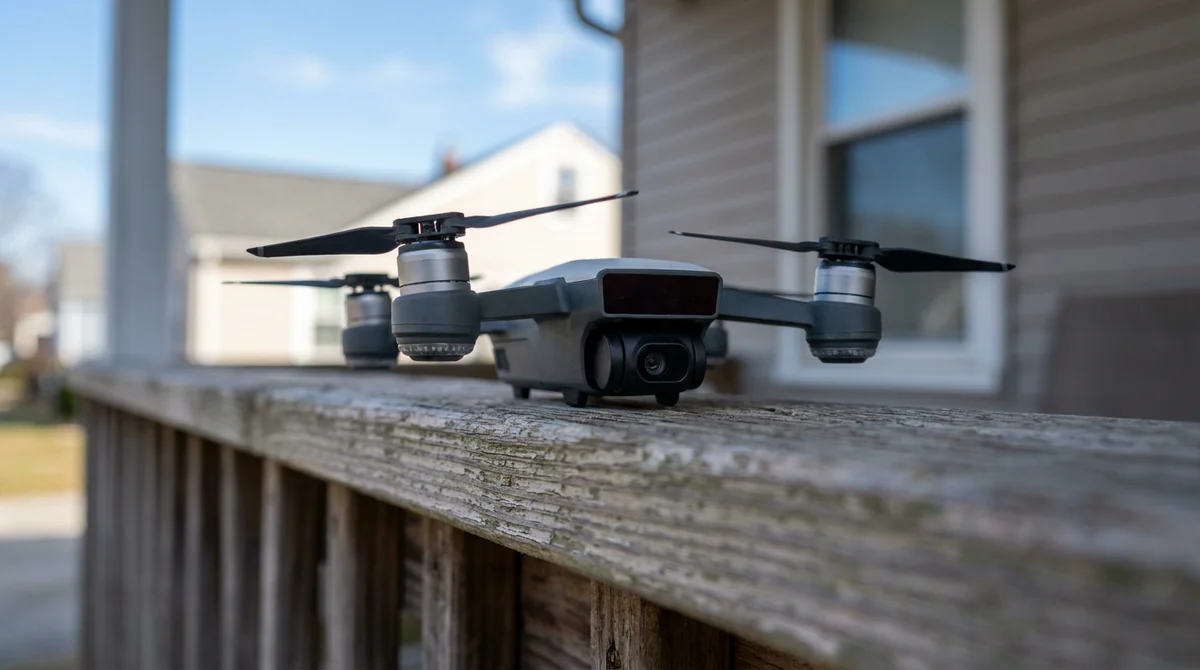
| Drone | Sub-250g consumer drone (DJI Mini 4 Pro or equivalent) | $760-1,000 |
| Software | Lightroom/Photoshop + a staging and enhancement tool | $30-60/month |
Total: roughly $3,000-6,000 for the camera body, lens, tripod, lighting, and drone combined. This is also the tier where the math from our guide to real estate photography pricing starts to matter: a full-frame body and a fast wide lens let you shoot dim interiors and twilight exteriors without a lighting truck, which is exactly what a tiered Premium package is selling.
A sub-250g drone matters for a practical reason beyond price: in the US it clears the FAA's registration threshold for hobbyist flying, though any paid commercial shoot still legally requires a Part 107 remote pilot certificate regardless of drone weight.
Luxury / High-Volume Kit: $10,000+
This tier is for photographers booking multiple luxury listings a month, or agencies running more than one shooter. The extra spend buys redundancy and image quality that shows up in $1M+ listing photography, not speed.
| Category | Pick | Typical price |
|---|---|---|
| Camera | High-resolution full-frame (Sony a7R V, 61MP) + a backup body | $4,500-6,500 combined |
| Lens | Tilt-shift architectural lens (Canon TS-E 17mm or equivalent) plus a standard wide zoom | $2,500-3,500 |
| Tripod | Geared-head tripod for precise level and perspective control | $600-900 |
| Lighting | Two-head studio strobe kit (Profoto B10-class) with softboxes | $2,500-4,000 |
| Drone | Higher-end drone (DJI Air 3 or Mavic 3-class) plus Part 107 certification and insurance | $1,700-2,400 |
| Software | Full Creative Cloud + Capture One + an AI staging/video suite | $80-120/month |
Total: $10,000-15,000+, plus recurring insurance and certification costs. A tilt-shift lens is the one item in this tier that's genuinely a skill investment, not just a purchase: it corrects converging verticals in-camera, but it has a learning curve and a narrow use case. Don't buy one until you're already booking the kind of architectural work that demands it.
Tier Comparison at a Glance
| Starter | Working Pro | Luxury | |
|---|---|---|---|
| Total equipment cost | $1,000-1,500 | $3,000-6,000 | $10,000-15,000+ |
| Best for | First paying shoots | 5-8 listings/week | Multi-shooter agencies, $1M+ listings |
| Camera | APS-C mirrorless | Full-frame mirrorless | High-res full-frame + backup |
| Drone included | No | Yes (sub-250g) | Yes (certified pilot) |
| Break-even | 5-10 shoots | 15-25 shoots | 40-60 shoots |
Break-even assumes a $200-300 average shoot price and doesn't include your time. It's a rough guide for how many bookings it takes before the gear has paid for itself, not a guarantee.
Camera and Lens: The Two Decisions Worth Getting Right
Every other item on this list is replaceable without changing your output much. The camera and lens are not: they set the ceiling on image quality and how fast you can work. We've written dedicated breakdowns on choosing a real estate photography camera and picking the right lens for interiors, covering sensor size trade-offs, focal length math for small rooms, and the specific bodies and lenses that hold their resale value. If you only read two more articles before buying anything, make it those.
The short version: buy the widest rectilinear lens your budget allows before you upgrade the camera body. A $700 camera with a genuinely wide, distortion-corrected lens will out-photograph a $3,000 body paired with a kit zoom every time a room is small, and in real estate, most rooms are small.
What to Skip at Every Tier
Overspending on real estate photography equipment usually follows the same pattern: buying capability before you have the bookings to use it.
- A second camera body before you have steady weekly bookings. Redundancy matters once a missed shoot costs you a client relationship, not before.
- A full studio lighting kit for your first year. Natural light plus one bounced flash covers the vast majority of listings. Strobes earn their keep on volume, not on day one.
- A drone before you've turned down aerial requests. Renting a licensed pilot for the occasional acreage listing is cheaper than owning, certifying, and insuring a drone you fly twice a month.
- A tilt-shift lens before a wide rectilinear zoom. Tilt-shift is a specialist tool for a specialist niche. Master perspective correction in post before you buy a lens that only does one thing.
- Multiple overlapping editing subscriptions. Paying for Lightroom, a separate HDR blender, and a separate staging tool when one AI-powered workflow now covers exposure blending, sky replacement, and staging in a single pass.
Software Is Where Margin Actually Lives
Camera gear determines what you can capture. Software determines what you can sell. This is where the equipment conversation connects directly to margin: whether real estate photographers should offer virtual staging as an upsell, and which AI tools are worth adding to the workflow.
A raw photo editor (Lightroom or Capture One) is non-negotiable at every tier: it handles exposure blending, lens distortion correction, and color grading. Beyond that, the highest-leverage software purchase is a staging and enhancement tool that turns the photos you already shot into more billable deliverables: virtual staging, item removal, twilight conversion, and sky replacement. RoomLift's real estate photo editing tools do all four in one place, for $1-5 per image instead of the $25-75 a separate staging vendor charges per room.
The same logic now extends to video. Agents increasingly want a walkthrough clip for the MLS listing, Instagram Reels, and TikTok, but a $300-500 videographer shoot doesn't fit every listing's budget. RoomLift's Compose tool turns the stills you already captured into a polished property-tour video in minutes, complete with AI camera motion that animates each photo into a smooth shot, an AI voiceover, and background music matched to the property, exported in whatever aspect ratio the platform needs.
Turn the photos you already shot into a property-tour video with Compose, no extra shoot required.
Stage your first room in 20 seconds. No design skills needed.
Buy for the Bookings You Have, Not the Ones You Want
The most common mistake with real estate photography gear is sequencing: photographers buy the luxury kit before they've booked a single luxury listing. Start at the tier that matches your current volume, reinvest the margin from your first 20-30 shoots, and upgrade one component at a time: lens before body, tripod before lighting, software before drone. Structuring your pricing so the gear pays for itself faster is worth getting right from day one.
Frequently Asked Questions
What real estate photography equipment do I need to get started?
At minimum you need a mirrorless camera with a wide-angle lens (roughly 16-24mm full-frame equivalent), a tripod, and photo-editing software. A starter kit covering all three runs under $1,500. Lighting and a drone are useful upgrades but not required for your first paying shoots.
Do I need a full-frame camera for real estate photography?
No. A modern APS-C mirrorless body paired with a true wide-angle lens will produce listing-quality images agents are happy to pay for. Full-frame bodies earn their cost once you're shooting high-volume or luxury listings where dynamic range and low-light performance in dim interiors start to matter.
What is the best lens for real estate photography?
A rectilinear wide-angle lens in the 12-20mm (APS-C) or 16-24mm (full-frame) range is the standard choice because it captures whole rooms without the barrel distortion of a fisheye. Avoid ultra-wide fisheye lenses for listing photos: agents and MLS reviewers notice the bowed walls.
Do real estate photographers need a drone?
A drone is optional for standard listings but expected for anything with acreage, waterfront, or a notable exterior. In the US, commercial drone work legally requires an FAA Part 107 certificate. If aerial shots make up under 10% of your bookings, renting or subcontracting a licensed drone pilot is usually cheaper than buying and certifying yourself.
How much does a full professional real estate photography kit cost?
A working-pro kit (full-frame body, wide lens, carbon tripod, a compact lighting setup, and a sub-250g drone) typically runs $3,000 to $6,000. A luxury-tier kit with a backup body, studio strobes, and a higher-end drone can reach $10,000 to $15,000, though most photographers never need to go that far.
What software do real estate photographers need?
At minimum, a raw photo editor like Lightroom or Capture One for exposure blending and lens corrections, plus a tool for virtual staging, sky replacement, and twilight conversion. AI tools like RoomLift now handle staging and enhancement for $1-5 per image, replacing what used to require separate compositing software.
Ready to transform your listings?
Stage your first room in 20 seconds. No design skills needed.