Best Camera for Real Estate Photography in 2026
Jul 27, 2026 · 11 min read
The best camera for real estate photography in 2026, compared by budget: full-frame vs. crop vs. phone, real prices, and the specs that actually matter.
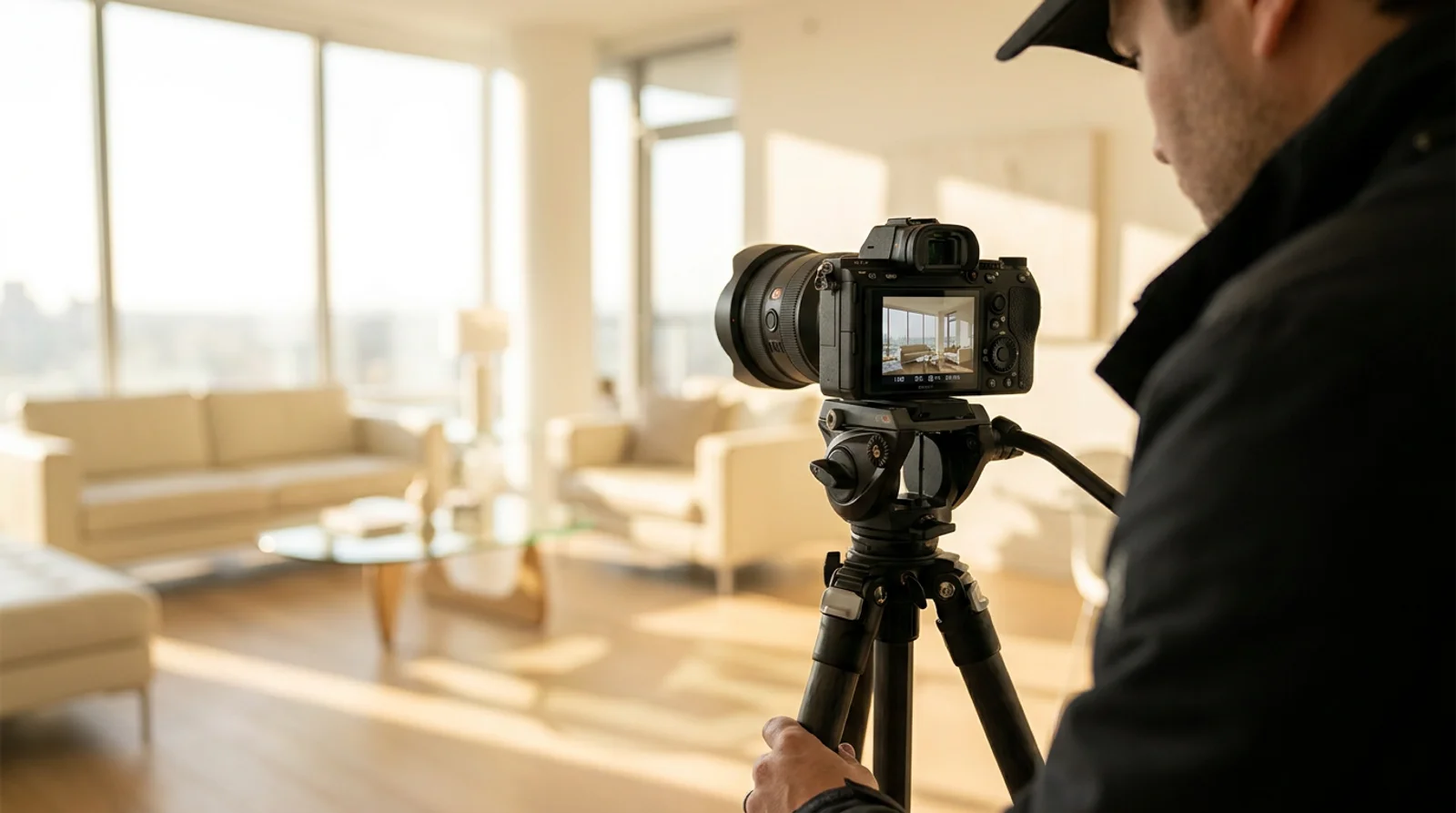
The best camera for real estate photography in 2026 is a full-frame mirrorless body with a wide rectilinear lens, something like a Canon EOS R8 or Sony a7 IV paired with a 16-35mm zoom, running roughly $2,000-2,800 for the full kit. If that's more than your business needs right now, a crop-sensor mirrorless camera like the Nikon Z50 II or Canon EOS R10 will produce perfectly listing-ready photos for about $1,000-1,400. What actually separates a good real estate camera from a bad one is dynamic range, wide-angle lens support, and HDR bracketing, not the megapixel count on the box.
This guide breaks down the real 2026 pricing across budget tiers, the specs worth paying for, an honest look at phone cameras, and where AI editing can close the gap between the gear you have and the gear you'd like to have.
What Actually Matters in a Real Estate Camera
Real estate interiors are one of the hardest scenes in photography: a single frame often needs to hold detail in a sunlit window, a shadowed corner, and a warm interior light source, all at once. Three specs decide whether a camera can handle that.
Dynamic range. This is the range of brightness a sensor can capture in one exposure before highlights blow out to white or shadows crush to black. Full-frame sensors typically deliver 1-2 more stops of dynamic range than APS-C (crop) sensors of the same generation, which is the difference between salvaging a bright window in editing and losing it entirely.
Wide-angle lens support. A living room shot from the doorway needs roughly a 16-24mm full-frame equivalent to fit the whole space without a fisheye look. Not every lens system offers a clean, distortion-corrected wide zoom, so check lens availability before you commit to a camera body.
HDR bracketing. This is the camera's ability to fire a burst of exposures (typically 3 to 7 frames) at different brightness levels in one shutter press, which get merged into a single balanced image. Almost every mirrorless body sold since 2022 supports this natively; it's a firmware feature, not a hardware one, so don't pay a premium for a body that claims to have "better" bracketing than a competitor at the same price.
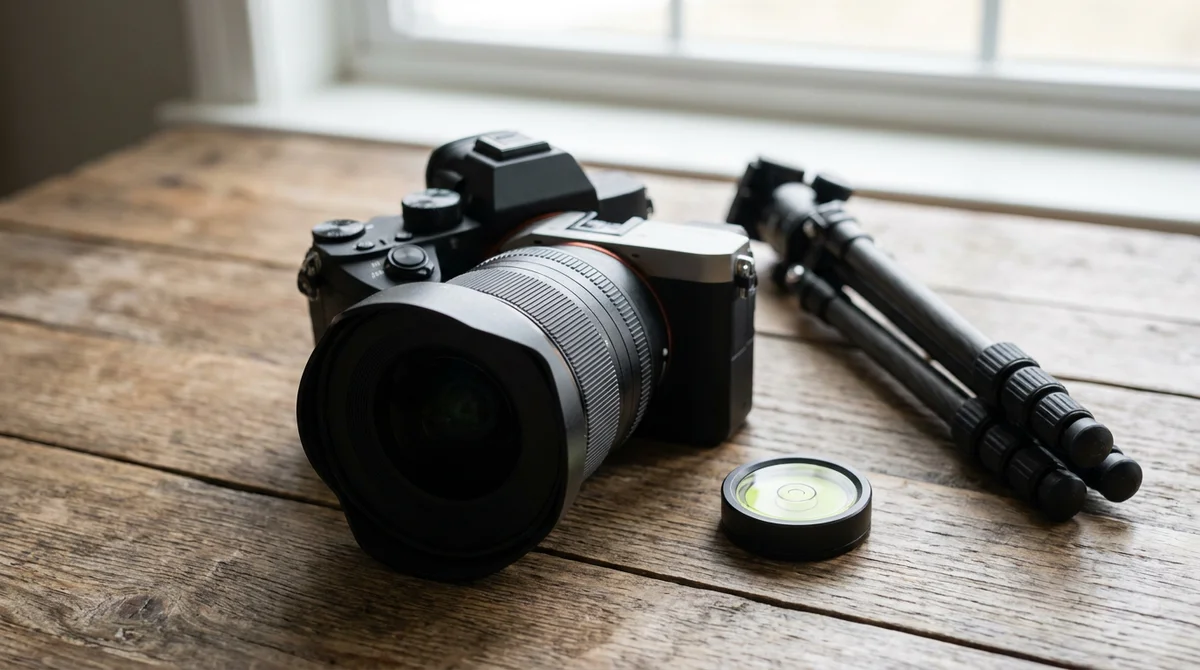
A fourth factor matters more than most buying guides admit: weight and battery life. If you're shooting 4-6 listings a week, a lighter body with a tripod-friendly grip and a battery that lasts a full day saves real time and fatigue that no spec sheet captures.
Full-Frame vs. Crop vs. Phone: How They Compare
Here's the practical trade-off across the three formats photographers actually choose between.
| Full-frame mirrorless | Crop-sensor (APS-C) mirrorless | Flagship smartphone | |
|---|---|---|---|
| Dynamic range | Best | Good | Fair (computational, not true bracketing) |
| Wide-angle options | Excellent, native 16-35mm zooms | Good, 10-18mm zooms | Fixed ultra-wide, visible edge distortion |
| Low-light interiors | Excellent | Good | Weak in mixed/warm lighting |
| Typical body price (2026) | $1,500-4,300 | $800-1,400 | $0 (already owned) |
| Learning curve | Moderate | Moderate | Low |
| Best for | Luxury listings, twilight, agencies shooting daily | Standard listings, photographers starting out | Owner-occupied quick shots, backup camera |
The pattern holds across brands: every full-frame step up buys you more dynamic range and better lens choices, and every step down in sensor size trades some of that headroom for a lower price and lighter bag.
Best Real Estate Cameras by Budget Tier (2026 Prices)
Street prices moved only modestly across the mirrorless market in 2025-2026, so this is a realistic range for a body plus a wide zoom lens, the two purchases that actually affect your output.
| Budget tier | Example bodies | Wide lens pairing | Typical kit price |
|---|---|---|---|
| Starter (crop-sensor) | Canon EOS R10, Nikon Z50 II | Canon RF-S 10-18mm or Nikon 12-28mm | $1,000-1,400 |
| Value full-frame | Canon EOS R8, Panasonic Lumix S9 | Sigma 16-28mm f/2.8 or Canon RF 16mm f/2.8 | $2,000-2,800 |
| Prosumer full-frame | Sony a7 IV, Nikon Z6 III | Sony FE 16-35mm f/4 or Nikon Z 17-28mm f/2.8 | $3,300-4,200 |
| Pro / high-resolution | Sony a7R V, Canon EOS R5 Mark II | 16-35mm f/2.8 (GM or RF) | $5,200-6,700 |
The value full-frame tier is where most working real estate photographers land: it's the first price point where dynamic range stops being a limitation, without paying for resolution and burst speed you don't need for still interiors. Save the pro tier for agencies handling luxury listings, twilight-heavy markets, or high-volume drone-plus-video packages, where the extra resolution and lens speed pay for themselves. For a sense of how gear cost fits into your overall business math, see our breakdown of real estate photography pricing.
Why Dynamic Range Is the Spec That Matters Most
A single exposure often can't hold both a bright exterior view and a properly lit interior, which is exactly the failure mode HDR bracketing exists to fix. Drag the slider to see the same room shot as a single flat exposure versus an HDR-merged result:
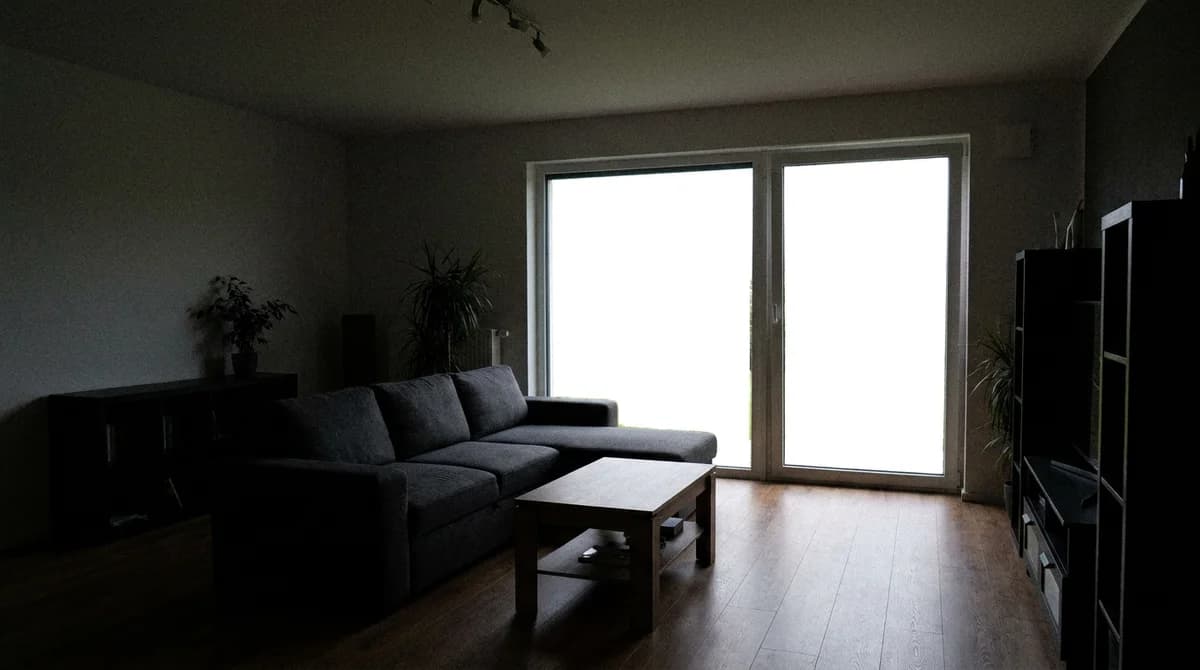
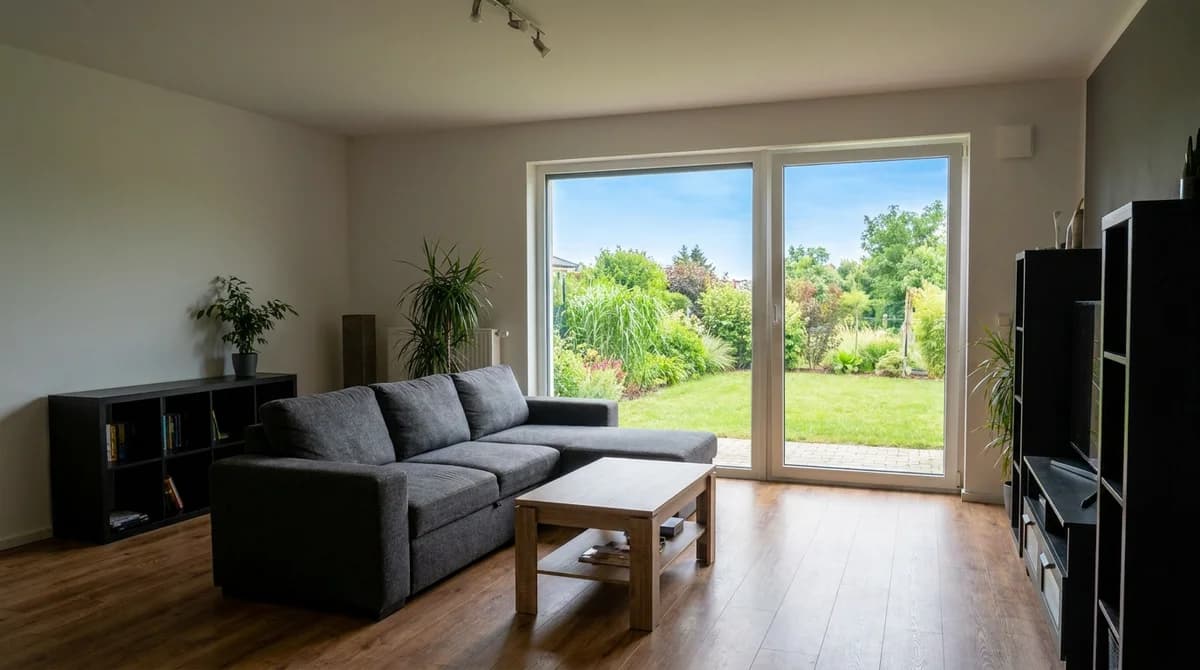
This is the everyday case for HDR bracketing, not a rare edge scenario. Any room with a window facing outdoor light needs it, which is most rooms photographed for a listing. A camera with wider native dynamic range needs fewer bracketed frames (sometimes just 3 instead of 7) to get a clean merge, which speeds up both the shoot and the edit.
The Honest Take on Phone Cameras
Flagship phones in 2026 are genuinely capable of clean, well-composed interior shots in good light, and plenty of agents shoot their own listings on an iPhone or Pixel with acceptable MLS results. Where phones fall short is consistency: small sensors struggle the moment a room has mixed color temperatures (daylight through a window plus warm interior bulbs), and the fixed ultra-wide lens shows visible barrel distortion on straight lines like door frames and cabinetry that a dedicated wide-angle lens corrects for.
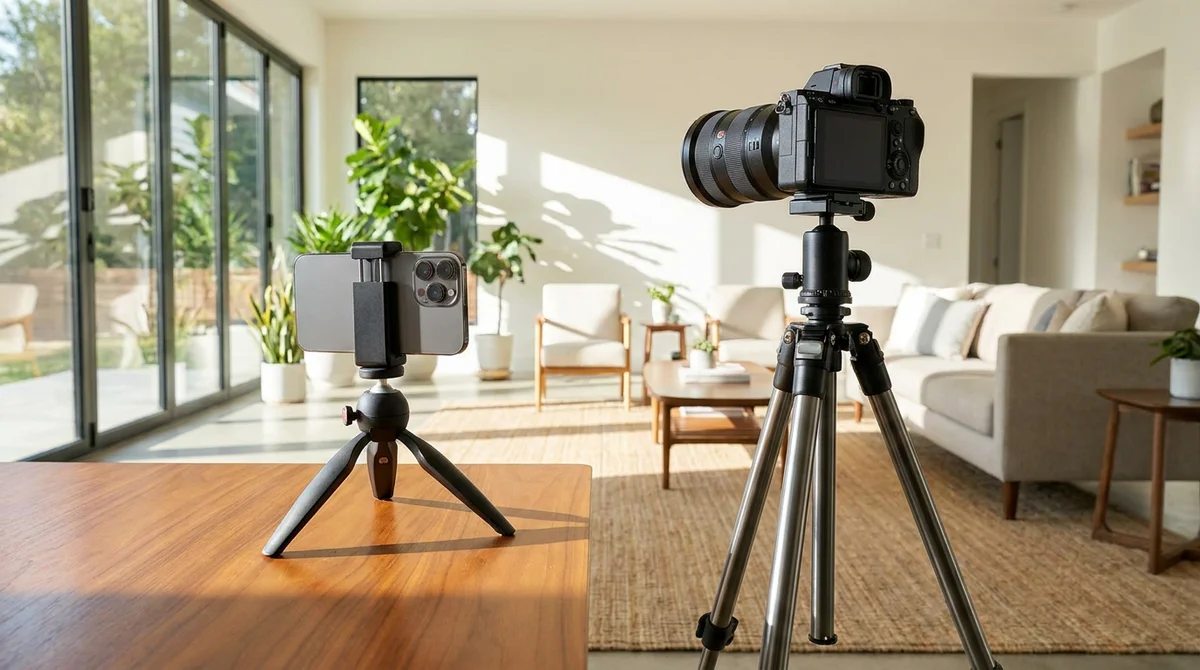
For a photographer building a business, the honest answer is that a phone is a fine backup camera and a reasonable way to shoot your first few listings while you save for real gear, but it isn't a long-term substitute once you're charging professional rates. Most photographers who start on a phone upgrade once they're shooting listings regularly, usually the moment a client complains about warped lines or a blown-out window. Our guide to AI tools for real estate photographers covers how to layer software on top of whichever camera you're shooting with.
Where AI Editing Reduces Gear Pressure
Good gear still matters, but the pressure to buy the newest, most expensive body has eased considerably as AI editing has gotten better at rescuing and extending what a camera captures. HDR merging, perspective correction, sky replacement, and virtual staging all happen in software now, which means a photographer on a value full-frame kit can deliver results that used to require a pro-tier body and a lot more post-processing time. Our own real estate photo editing tools handle exactly this: staging, twilight conversion, and cleanup on images shot with mid-tier gear.
That same logic extends past stills. Once you've captured clean listing photos, RoomLift's Compose tool turns those same images into a polished video tour, complete with AI camera motion that animates each still into a smooth shot, an AI voiceover, and background music matched to the property, all without owning a gimbal, a second camera body, or video-specific glass. You can even generate close-up detail shots from a single wide photo. It won't replace a videographer's eye on a $2 million listing, but for the weekly volume of standard listings, it turns photos you already have into a video deliverable in minutes instead of the days a traditional videographer needs.
Already have the listing photos? Turn them into a property tour video with Compose in minutes, no extra gear required.
Stage your first room in 20 seconds. No design skills needed.
Common Gear Mistakes to Avoid
A few habits quietly hold photographers back regardless of which camera they buy:
- Buying a fast prime instead of a wide zoom. Real estate interiors need coverage, not shallow depth of field. A wide zoom at f/8 does more work than any f/1.4 lens.
- Skipping the tripod. Bracketed HDR shots need a stable base; handheld brackets rarely align cleanly, and misalignment shows up as ghosting around furniture edges.
- Chasing megapixels over dynamic range. A 60-megapixel sensor with mediocre dynamic range still blows out windows. Prioritize the spec that solves your actual problem.
- Ignoring lens distortion correction. Cheap wide lenses without in-camera or software correction leave visibly curved walls and doorframes that read as unprofessional even on an otherwise good shot.
- Upgrading gear before fixing workflow. A photographer struggling with turnaround time or upsell revenue usually has a process problem, not a camera problem. Review your real estate photo editing workflow before your next gear purchase.
Putting It Together
There's no single best camera for every real estate photographer, only the best camera for your current volume and pricing tier. Starting out or shooting occasionally, a crop-sensor mirrorless kit at $1,000-1,400 will produce clean, listing-ready photos. Once you're shooting regularly and charging professional rates, a value full-frame kit at $2,000-2,800 pays for itself through better dynamic range and fewer reshoots. Reserve the pro tier for luxury and twilight-heavy work where the extra resolution and lens speed genuinely show up in the final image. Whatever body you land on, spend on the wide lens and the tripod before you spend on megapixels, and let AI editing handle the gap between what your sensor captured and what the listing needs to look like.
For an overview of how camera choice fits into your broader listing checklist, see our MLS photo requirements guide, and if you're comparing full editing suites rather than gear, our best real estate photo editing software roundup covers the tools that pair with any of the cameras above.
Frequently Asked Questions
What is the best camera for real estate photography in 2026?
For most working photographers, a full-frame mirrorless body like the Canon EOS R8 or Sony a7 IV paired with a wide rectilinear lens (16-24mm equivalent) is the best balance of image quality, dynamic range, and price, typically $2,000-2,800 for the full kit. If budget is the main constraint, a crop-sensor body like the Nikon Z50 II or Canon EOS R10 delivers listing-ready results for roughly $1,000-1,400.
Do I need a full-frame camera for real estate photography?
No, but it helps. Full-frame sensors typically capture 1-2 more stops of dynamic range than APS-C, which matters when a single frame has to hold detail in both a bright window and a shadowed interior. Crop-sensor cameras are perfectly capable for standard listings and cost roughly 40-50% less; full-frame earns its price back on luxury listings and twilight work.
Can I shoot real estate photography with just a smartphone?
Yes, for basic MLS compliance shots, and no, for anything you want to compete with. A 2026 flagship phone can produce clean, well-lit stills of a tidy room, but small sensors struggle with mixed lighting, wide-angle shots show visible distortion, and there is no true HDR bracketing workflow. Most photographers who start on a phone upgrade once they're shooting listings regularly and charging professional rates.
What lens should I use for real estate photography?
A wide rectilinear zoom in the 16-35mm range (full-frame) or 10-18mm range (crop-sensor) is the standard choice, because it captures a full room without the barrel distortion of a fisheye. A constant f/2.8 or f/4 aperture with minimal edge softness matters more than a fast maximum aperture, since most real estate shots are taken at f/8-f/11 anyway.
How much should I budget for a real estate photography camera setup?
A complete starter kit, body plus wide lens plus a basic tripod, runs $1,000-1,400 on a crop-sensor system and $2,000-2,800 on entry full-frame. Add a bracketing-capable tripod head and a spare battery and most photographers are shooting professionally for under $3,000 total, well below the $4,000-6,000 that pro-tier full-frame bodies and lenses cost.
Does AI editing reduce the need for expensive camera gear?
It reduces the pressure, not the value of a good camera. AI-based HDR merging, perspective correction, and virtual staging can rescue a mediocre exposure and add services a camera alone can't, but they can't invent detail a small, noisy sensor never captured. The practical effect is that photographers can buy one tier down and let software close the remaining gap.
Ready to transform your listings?
Stage your first room in 20 seconds. No design skills needed.