
Kostenloses PDF · Interior Designers
Client-ready room concepts on the first try.
Seventeen tested prompts for photorealistic concept renders, written briefs, and mood board narratives. Distilled from over a thousand production runs.
- Kostenlos
- Keine Kreditkarte
- 20 Seiten
- Sofort verfügbar
Kostenloses PDF
Ihr Exemplar anfordern
Wir senden Ihnen den Leitfaden und ein paar Tipps per E-Mail. Abmeldung jederzeit möglich.
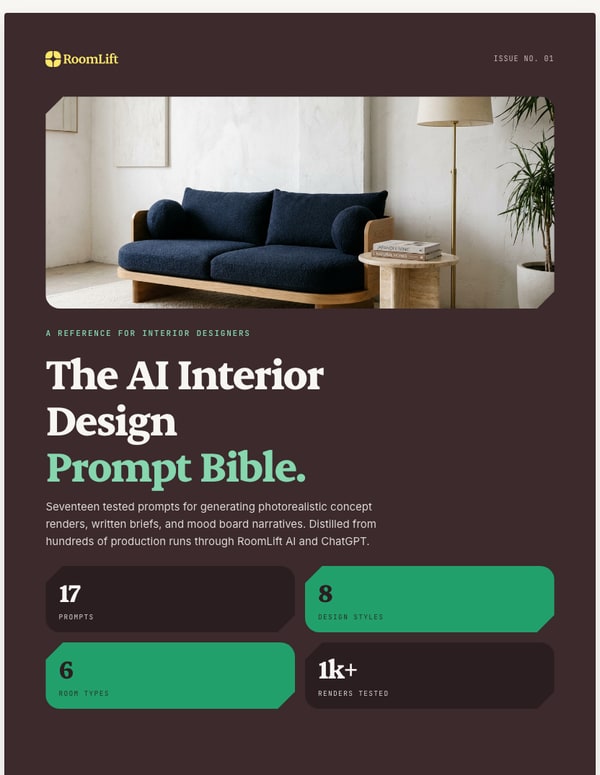
- 17
- Prompts
- 8
- Design styles
- 6
- Room types
- 20
- Pages
Blick ins Buch
Echte Seiten aus dem Leitfaden.
Seite 3
Seite 5
Seite 7
Seite 9
Was ist enthalten
Was Sie bekommen.
Room concepts
Fourteen prompts across six room types, each written for a specific client situation rather than a generic room.
- Living rooms in Japandi, Scandi, modern organic and maximalist
- Primary, guest and children's bedrooms
- Modern, farmhouse and Japandi kitchens
- Home offices, studios and bathrooms
Client documents
The writing you still owe the client once the render is done.
- Design concept summary
- Mood board narrative
- Scope of work email
The one page playbook
The whole workflow from room photo to client presentation, on a single page you can print.
- Which prompt to reach for at each project stage
- How to pair a written concept with a render
- What to put in front of the client, and in what order
Kostenlose Leseprobe
Japandi living room
Diesen Prompt kopieren
Write a design concept description for a Japandi living room for a {couple/family/single professional} in a {city apartment/suburban home/townhouse}. Room dimensions: {dimensions}. Key requirements: {requirements}. Include: material palette (woods, textiles, stone), furniture approach, lighting plan, and 3 specific product categories to source. Keep the tone editorial, suitable to share with the client.
- Style
- Japandi
- Room type
- Living room
- Quality
- Pro
Warum das funktioniert
- The bracketed inputs force concrete output. Generic Japandi prompts produce generic Japandi rooms.
- Asking for 3 product categories anchors the model in shoppable specifics instead of aesthetic abstractions.
- Asking for an editorial tone suppresses the breathless marketing voice ChatGPT defaults to.
Das passt zu Ihnen, wenn
- You present concepts to clients and need them to look finished
- You want a repeatable prompt library instead of starting from a blank box
- You already use ChatGPT but the output reads generic
- You bill for e-design or remote consultations
- You are comfortable working from a photo of the real room
Das passt nicht zu Ihnen, wenn
- −You need construction-grade CGI for a planning submission
- −You want fully automated design with no judgement applied
- −You work only in CAD and never present visuals
- −You are looking for furniture sourcing, not visualization
Der ehrliche Vergleich
Why not just ask ChatGPT for prompts?
| Prompts you write yourself | Prompts from this guide |
|---|---|
| Generic wording that ignores the room you actually have | Written against real room photos and real client briefs |
| A different look in every image of the same project | One style vocabulary you can hold across a whole project |
| Style words the image model does not reliably recognize | Style names that map to tested RoomLift presets |
| No render setting to go with the written concept | Every prompt names the settings that produced the render |
| Trial and error on every new room | The version that already survived a thousand runs |
These prompts were not written in one sitting. They came out of more than a thousand production runs, where we could watch which phrasing produced a render a designer would actually put in front of a client, and which produced a stock photo of nobody's home. The notes next to each prompt are the part worth reading.
The RoomLift team
Bevor Sie fragen
Fragen, ehrlich beantwortet.
Kostenloses PDF
The AI Interior Design Prompt Bible: 17 Tested Prompts by Room and Style
Wir senden Ihnen den Leitfaden und ein paar Tipps per E-Mail. Abmeldung jederzeit möglich.